The Sources of Success of Southwest Airlines
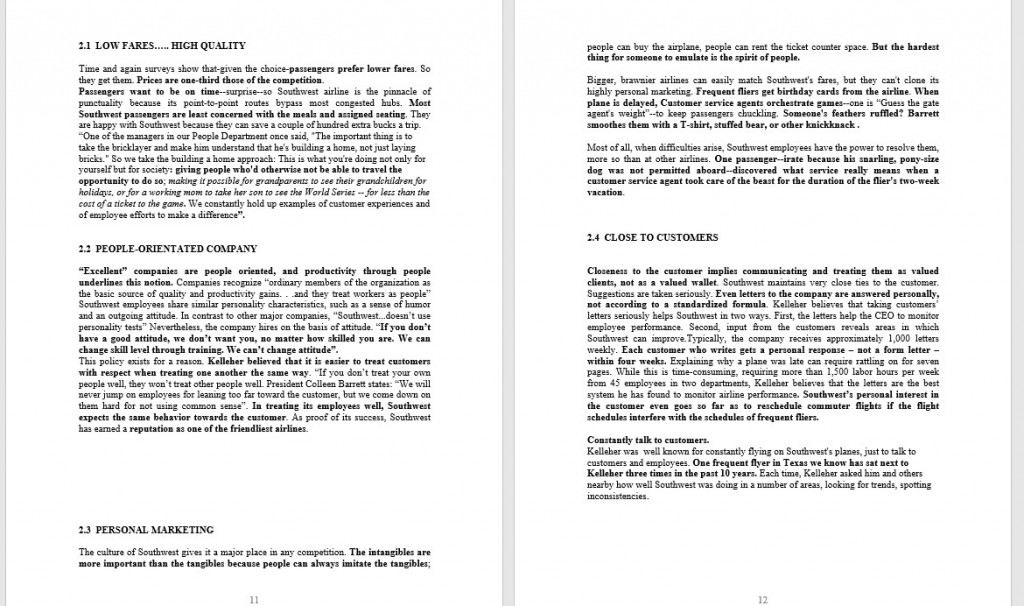
In an industry that's roundly reviled by customers, Southwest Airlines largely stands alone. Thanks to the extremely effective, maverick-cum-evangelistic leadership of Kelleher, Southwest has outlasted competitors big and small to become bigger than all of them combined.
1. IMPROVED EFFICIENCY
Southwest didn’t play by the old rules. It introduced various key efficiencies:
1.1 SIMULTANEOUS LOOSE-TIGHT PROPERTIES
Simultaneous loose-tight properties can be achieved through a company “both centralized and de-centralized. . .They are fanatical centralists around the few core values they see as key to the enterprise: quality, reliability, action, regular informal communication, and quick feedback”. Southwest can be described by all these characteristics. The organization as a whole is democratic. Individual input is encouraged and hierarchy in general is de-emphasized . At the same time, Kelleher remained the unchallenged leader of Southwest. Kelleher personally approved every expenditure over $1,000 and considers having financial aspects under control as very important.
“No matter how good things may look, you should not let your spending get out of control’’.
Cost-Conscious but More Productive Kelleher was always very cost-conscious and he was constantly looking for ways to be more productive. He cut costs in his maintenance program by, for example, doing more works on a plane when it's in for a check instead of bringing it in three different times. He has also came up with a purchasing program that let him get discounts on everything from cleaning supplies to airport security.
NO FRILL FLIES……NO HOT MEALS….JUST PEANUTS!
Peanuts are served during a flight instead of meals. They are big in the peanut world. It is suspected that they buy about $9 million or $10 million worth of peanuts each year.
The average cost per passenger of serving meals is about $5, and their average cost per passenger is 20 cents. This makes a great difference in the budget. Absence of meal during a flight also saves cleaning time.
1.2 STICK TO THE KNITTING
“Stick to the knitting” is a metaphor that implies keeping focused on well-performed tasks and keeping off over-hastened expansion.
When they started the business they had to operate as an intrastate airline, that pretty well dictates the market niche. They built a low-cost, high-frequency point-to-point operation rather than the hub-and-spoke system that others had. And they made that apparent market weakness into an operational strength. With deregulation, that market strategy was in question. Suddenly any carrier was free to compete with any other. They could have brought in 747s and flown nonstop from New York to Los Angeles, or Dallas to London. It was a defining moment. Howard Putnam, president and CEO at the time, wisely asked people throughout the company to think about our future and the kind of organization we wanted to be. They decided not to go head to head with the international carriers, but to build on the strategy that had worked so well for them in the past.
Many companies expand too fast and then cannot deal with upcoming problems such as insufficient funds or lack of specialized expertise. Southwest’s former CEO Kelleher was cautious about expansion. Even though he has added many national flights, Southwest is not planning to compete with international airlines.
“We don’t intend to fly transcontinental”. Since most companies try to increase profit through expansion, keeping a company small and focused can be a new concept. Or, as Kelleher said, “You can innovate by not doing anything, if it’s a conscious decision”.
1.1.3 A BIAS FOR ACTION
A company showing a bias for action favors experimentation. Management encourages “can do” and “let’s try” problem solutions. Open-door policies and short deadlines are also typical. In general, companies with a bias for action are open for change and new innovations. At Southwest, open-door policies and “let’s try” approaches are part of the special Southwest perspective. Kelleher was classified as the sort of manager who will “stay out with a mechanic in some bar until four o’clock in the morning to find out what is going on. Then he will fix whatever is wrong”. Employees are encouraged to generate ideas and then try them. “Southwest workers often go out of their way to amuse, surprise, or somehow entertain passengers”. For example, employees may explain the usual safety regulations through rap-singing.
Employees often generate and implement solutions to problems on the spot instead of waiting for time-consuming top management decisions.
1.1.4 AUTONOMY AND ENTREPRENEURSHIP
Companies encouraging autonomy and entrepreneurship are characterized by innovators and risk takers on all levels. Internal competition is encouraged, not suppressed, and management fosters leaders on all levels. “Southwest is a company that encourages its people to express their individuality. . . Southwest’s culture also de-emphasizes hierarchy”. At Southwest, every employee can express opinions freely and make suggestions. For example, Southwest encourages leadership. As Jaffe explains: “We want everyone to be a leader in his job; you’re a leader not just in what you say, but in the way you listen and respond to others, in what you do, and most importantly, how you do it”. Internal competition at Southwest exists in a friendly and motivating way. “Departments shower one another with free ice cream, pizza, or other goodies as tokens of customer devotion – or simple in appreciation of a job well done”
Southwest also accepts failure as a natural and forgivable occurrence. “A special attribute of the success-oriented, positive, and innovating environment is a substantial tolerance for failure” Anne Bruce, manager of Southwest Airlines’ University for People employee learning and development division, explains Southwest’s rules for successful corporations. Among these rules are : walk a mile in someone else’s shoes; take accountability and ownership, and celebrate your mistakes as well as your triumphs.
1.1.5 SIMPLE FORM, LEAN STUFF
Keeping an organizational staff lean simplifies channels of communication in an organization. The more layers of hierarchy that exist, the longer it takes to make a decision, and the less familiar management is with daily occurrences. Since its establishment, Southwest has been leanly staffed. For example, in order to save time and money, flight attendants clean the planes themselves instead of ordering in a cleaning crew. Southwest constantly hires and rarely lays off new, so the term “lean staff” has to be defined in a relative sense. While other airlines hire in prosperous times and fire in more difficult times, the number of Southwest Airlines’ employees continues to grow but only to meet their needs. In this way, the company preserves its simple form with limited staff, even when growing from 198 to over 11,000 people between 1971 and 1993 .
1.1.6 COMPANY’S CULTURE – EMPOYEES PARTNERSHIP
SOUTHWEST’S real accomplishment is to have inspired their people to buy into a concept, to share a feeling and an attitude, to identify with the company -- and then to execute.
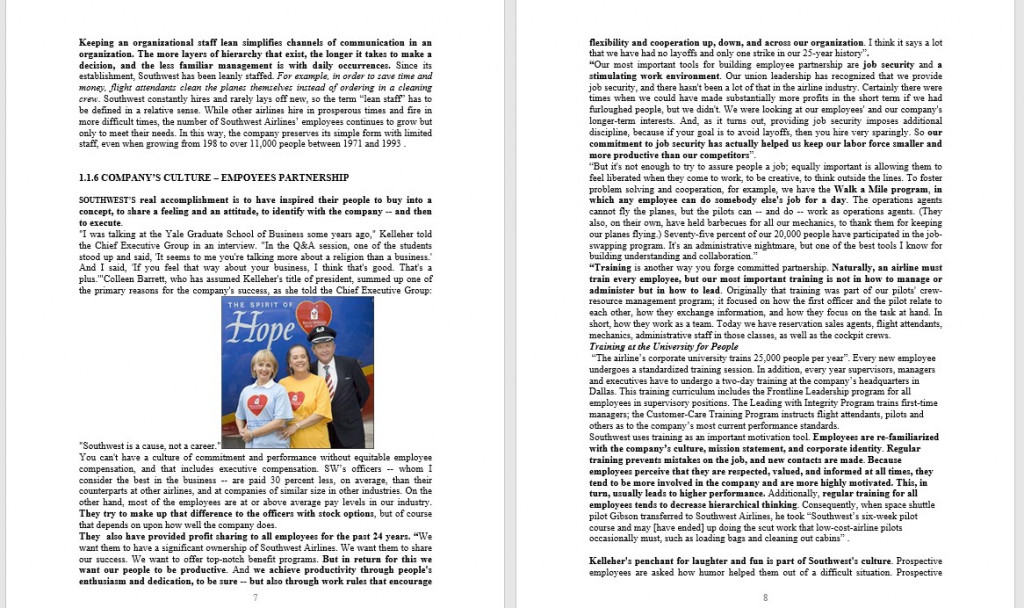
"I was talking at the Yale Graduate School of Business some years ago," Kelleher told the Chief Executive Group in an interview. "In the Q&A session, one of the students stood up and said, 'It seems to me you're talking more about a religion than a business.' And I said, 'If you feel that way about your business, I think that's good. That's a plus.'"Colleen Barrett, who has assumed Kelleher's title of president, summed up one of the primary reasons for the company's success, as she told the Chief Executive Group: "Southwest is a cause, not a career."
You can't have a culture of commitment and performance without equitable employee compensation, and that includes executive compensation. SW’s officers -- whom I consider the best in the business -- are paid 30 percent less, on average, than their counterparts at other airlines, and at companies of similar size in other industries. On the other hand, most of the employees are at or above average pay levels in our industry. They try to make up that difference to the officers with stock options, but of course that depends on upon how well the company does.
They also have provided profit sharing to all employees for the past 24 years. “We want them to have a significant ownership of Southwest Airlines. We want them to share our success. We want to offer top-notch benefit programs. But in return for this we want our people to be productive. And we achieve productivity through people's enthusiasm and dedication, to be sure -- but also through work rules that encourage flexibility and cooperation up, down, and across our organization. I think it says a lot that we have had no layoffs and only one strike in our 25-year history”.
“Our most important tools for building employee partnership are job security and a stimulating work environment. Our union leadership has recognized that we provide job security, and there hasn't been a lot of that in the airline industry. Certainly there were times when we could have made substantially more profits in the short term if we had furloughed people, but we didn't. We were looking at our employees' and our company's longer-term interests. And, as it turns out, providing job security imposes additional discipline, because if your goal is to avoid layoffs, then you hire very sparingly. So our commitment to job security has actually helped us keep our labor force smaller and more productive than our competitors”.
“But it's not enough to try to assure people a job; equally important is allowing them to feel liberated when they come to work, to be creative, to think outside the lines. To foster problem solving and cooperation, for example, we have the Walk a Mile program, in which any employee can do somebody else's job for a day. The operations agents cannot fly the planes, but the pilots can -- and do -- work as operations agents. (They also, on their own, have held barbecues for all our mechanics, to thank them for keeping our planes flying.) Seventy-five percent of our 20,000 people have participated in the job-swapping program. It's an administrative nightmare, but one of the best tools I know for building understanding and collaboration.”
“Training is another way you forge committed partnership. Naturally, an airline must train every employee, but our most important training is not in how to manage or administer but in how to lead. Originally that training was part of our pilots' crew-resource management program; it focused on how the first officer and the pilot relate to each other, how they exchange information, and how they focus on the task at hand. In short, how they work as a team. Today we have reservation sales agents, flight attendants, mechanics, administrative staff in those classes, as well as the cockpit crews.
Training at the University for People
“The airline’s corporate university trains 25,000 people per year”. Every new employee undergoes a standardized training session. In addition, every year supervisors, managers and executives have to undergo a two-day training at the company’s headquarters in Dallas. This training curriculum includes the Frontline Leadership program for all employees in supervisory positions. The Leading with Integrity Program trains first-time managers; the Customer-Care Training Program instructs flight attendants, pilots and others as to the company’s most current performance standards.
Southwest uses training as an important motivation tool. Employees are re-familiarized with the company’s culture, mission statement, and corporate identity. Regular training prevents mistakes on the job, and new contacts are made. Because employees perceive that they are respected, valued, and informed at all times, they tend to be more involved in the company and are more highly motivated. This, in turn, usually leads to higher performance. Additionally, regular training for all employees tends to decrease hierarchical thinking. Consequently, when space shuttle pilot Gibson transferred to Southwest Airlines, he took “Southwest’s six-week pilot course and may [have ended] up doing the scut work that low-cost-airline pilots occasionally must, such as loading bags and cleaning out cabins” .
Kelleher's penchant for laughter and fun is part of Southwest's culture. Prospective employees are asked how humor helped them out of a difficult situation. Prospective pilots are sometimes asked to don Southwest shorts; the ones who see the request as fun and a lark pass the interview. Kelleher once settled a legal dispute with another company over a trademarked slogan by publicly arm-wrestling the other company's CEO. Kelleher won. Kelleher was always ready to play the fool, whether dressing up as Elvis for Halloween or driving a Harley to a company picnic.
“I have told our people in the field -- mostly young people -- that my hope is that when they're talking to their grandchildren, they say that Southwest Airlines was one of the finest experiences they ever had; that it helped them grow beyond anything they thought possible”( Herb Kelleher”)
At Southwest Airlines, management wants employees to feel comfortable, reflecting its philosophy that an employee who is comfortable can think more freely and creatively. A casual dress policy reinforces the company's desire that people be themselves on the job. Regular celebrations bring employees together. These include "Spirit Parties," Culture parties, and weekly Deck Parties at headquarters. Activities at these events include gong shows, talent shows, dance contests, limbo contests, karaoke, and famous person look-alike themes.
The Culture Committee welcomes new employees with a New Hire Welcome Kit, which includes a bag, tee-shirt, badge holder, pen, and welcome letter. An employee recognition program in which employees recognize each other builds community within and across departments. For instance, one work group Committee recognizes flight attendants ten times per year with "Hokey Days," named for the broom apparatus used by flight attendants to sweep up the flights. Committee members choose two locations at which to honor flight attendants, greeting each arriving plane, waiting until passengers deplane, and then boarding with goodie bags. The committee members tell the flight attendants to relax, and then clean the airplane for them.
Similar recognition programs honor maintenance facilities, ramp agents, reservation centers, and various departments within headquarters. Almost every employee location is honored by at least one other work group each year.
1.7 FLYING ONLY 737’S
Since 1967, when Southwest first launched after a four-year legal battle to get its first plane off the ground, it has used Boeing 737 aircraft exclusively.
Aircraft manuals can be very thick as well as frequently updated. The solution is online manuals. But Boeing doesn't want just any Tom, Dick or Osama reading its manuals so the online site is heavily guarded with identity management tools. This meant SWA 's mechanics needed not only to log on to the site but also keep re-authorizing their sessions. This wasted time according to the mechanics' union and workers wanted compensation - or a better method.The two companies put their technology heads together, called in their identity management partner, Oblix, and came up with a secure way for the mechanics to log on at SWA and be background authenticated (and re-authorized) at Boeing as needed using the SHAREid product over SAML.